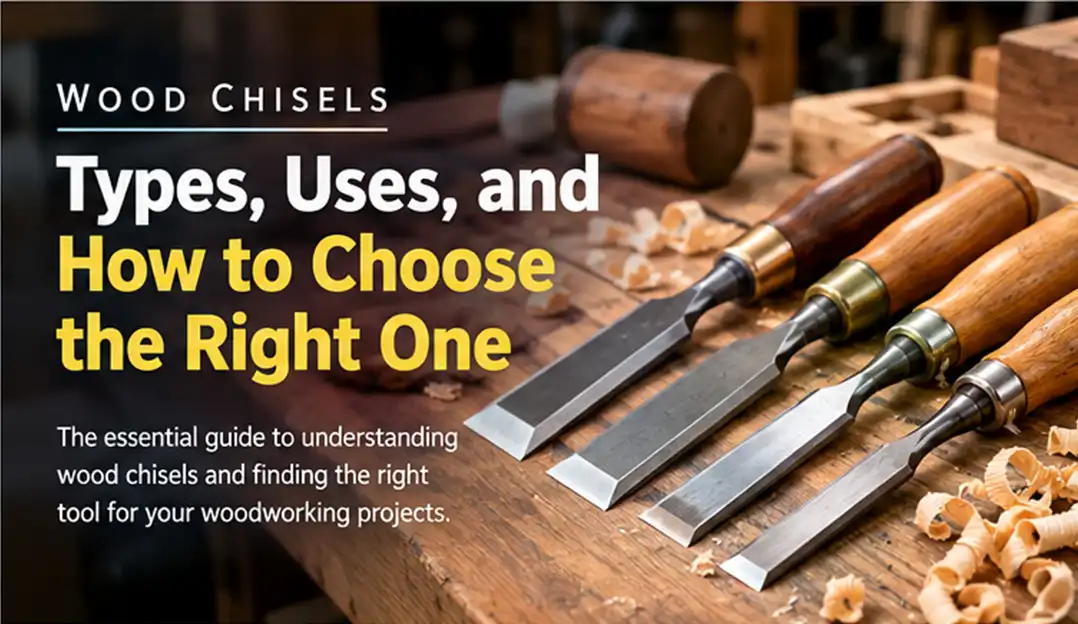
As an Amazon Associate, We earn from qualifying purchases. This helps support the blog at no extra cost to you. Thanks for your support!Wood chisels are one of the most useful hand tools in woodworking. You can use it to remove waste, clean joints, trim edges, cut mortises, fit hinges, and make small, controlled cuts that are difficult to achieve with a saw alone.
But not every chisel is designed for the same job.
A bevel-edge bench chisel is a versatile choice for everyday woodworking, while a mortise chisel is built for heavier chopping. A paring chisel is designed for controlled hand pressure and fine trimming. Choosing the right type can make your work easier and help you avoid damaging the wood or the tool.
In this guide, you’ll learn what wood chisels are, the main types, their uses, common sizes, how to choose one, and how to use and maintain them safely.
If you are specifically looking for product recommendations, see our guide to the best wood chisels for beginners.
Table of Contents
What is a Wood Chisel?
A wood chisel is a hand tool with a sharpened blade and a handle. It is designed to cut, pare, shape, and remove wood.
Unlike a saw, which cuts through material with repeated teeth, a chisel removes wood with a single cutting edge. You can push it by hand for controlled paring or strike it with a suitable mallet when more cutting force is needed.
Wood chisels are commonly used for:
- Cutting and cleaning joints
- Removing waste from mortises
- Trimming door hinges
- Cleaning dovetails
- Paring wood fibers
- Squaring routed corners
- Removing excess glue
- Fitting wooden parts
- General woodworking and DIY projects
A sharp, properly maintained chisel gives you much more control than a dull one. Experienced woodworking guidance also emphasizes keeping the workpiece secure and taking controlled cuts rather than forcing the tool.
Main Types of Wood Chisels
Wood chisels come in many shapes and sizes. You do not need every type to get started. The right choice depends mainly on the work you plan to do.
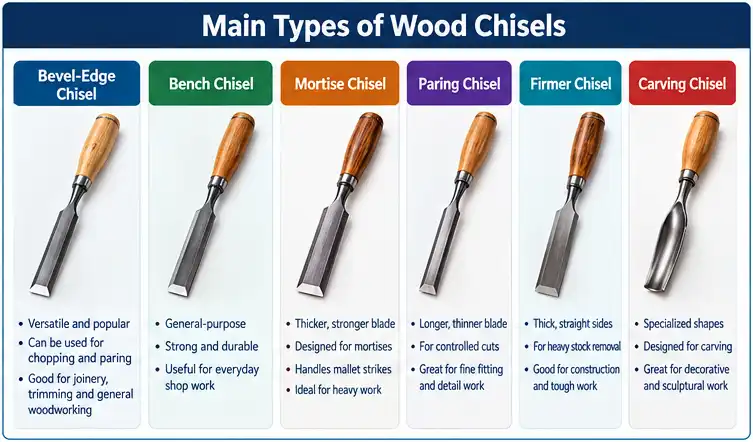
1. Bevel-Edge Chisels
Bevel-edge chisels are among the most versatile woodworking chisels.
The sides of the blade are beveled, allowing the chisel to reach into corners and tight joints more easily. They can be used for both chopping and paring, making them useful for general bench work and joinery.
Common uses
- Dovetail joints
- Tenons
- Mortise cleanup
- Plug trimming
- General woodworking
- Fitting joints
- Squaring corners
For many beginners, a small set of bevel-edge chisels is a practical starting point because the same tools can handle many common tasks.
2. Bench Chisels
Bench chisel is often used as a broad category for general-purpose woodworking chisels.
They are designed to remain useful for everyday shop work, including chopping and paring. Many bevel-edge chisels fall into this general bench-chisel category.
A bench chisel can be useful when you need one tool that can handle several different jobs.
Best for:
- General woodworking
- Joinery
- Trimming
- Small mortises
- Cleaning joints
3. Mortise Chisels
Mortise chisels have thicker, stronger blades than ordinary bench chisels.
They are designed for chopping and cleaning mortises, which are rectangular holes or recesses made to receive a tenon.
Their heavier construction allows them to withstand repeated mallet strikes.
Best for:
- Mortise-and-tenon joints
- Deep mortises
- Timber and furniture joinery
- Heavy chopping
A mortise chisel is usually unnecessary for a beginner who only does light woodworking, but it becomes useful when mortising becomes a regular part of your projects.
4. Paring Chisels
Paring chisels are designed for controlled, delicate cuts.
They generally have longer, thinner blades and are intended to be pushed by hand rather than struck repeatedly with a mallet.
Best for:
- Fine joint fitting
- Trimming tenons
- Removing thin layers of wood
- Cleaning dovetails
- Trimming plugs
- Final fitting work
The longer blade can also help you control the cut and register the tool against a surface.
5. Firmer Chisels
Firmer chisels have thicker, straighter-sided blades and are designed for stronger work.
They can be useful when more material needs to be removed or when the chisel will receive repeated impact. Woodcraft describes firmer chisels as construction-oriented chisels with thick blades for heavier stock removal.
Best for:
- Heavy woodworking
- Construction work
- Deeper cuts
- Tougher stock removal
For general furniture and cabinet work, a bevel-edge bench chisel may be more versatile.
6. Carving Chisels
Carving chisels are designed for shaping and decorative wood carving rather than general joinery.
Unlike a typical cabinetmaker’s chisel, carving chisels can have specialized blade shapes designed to remove material in different directions and create curves or details.
Best for:
- Decorative carving
- Sculpting wood
- Detailed shapes
- Artistic woodworking
If your main goal is furniture or joinery, you usually do not need a carving set.
Wood Chisel Anatomy
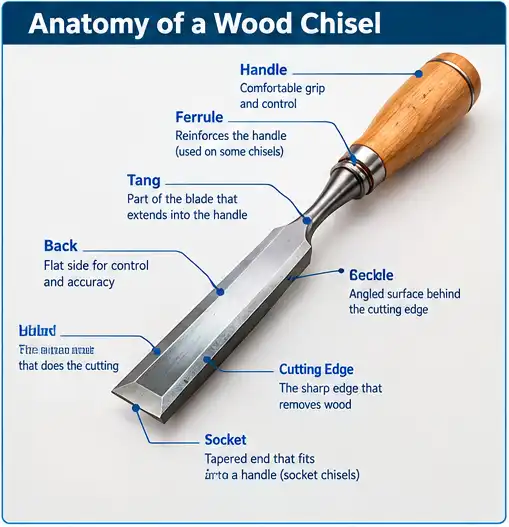
Understanding the basic parts of a chisel makes it easier to compare different tools.
Blade
The steel portion that performs the cutting.
Cutting Edge
The sharpened edge that contacts the wood.
Bevel
The angled surface ground behind the cutting edge.
Back
The relatively flat side of the blade. A flat, well-prepared back is important for controlled paring.
Tang
A portion of the blade that extends into the handle.
Socket
A socket-style construction uses a tapered blade end that fits into a matching handle.
Handle
The part you hold while using the tool.
Ferrule
A metal ring used on some handles to help reinforce the handle around the blade connection.
Understanding these parts helps you evaluate construction without relying only on brand names.
What Are Wood Chisels Used For?
A single good chisel can perform many jobs.
Cutting Mortises
Chisels are commonly used to clean and square mortises after removing much of the waste by another method.
For accurate work, it is better to remove most of the waste first and then use controlled chisel cuts to reach the layout lines.
Cutting and Cleaning Dovetails
A sharp bevel-edge chisel can remove waste from dovetail joints and clean the corners.
Trimming Tenons
Chisels are useful for removing small amounts of material from tenon shoulders and cheeks to improve the fit.
Installing Door Hinges
A chisel can cut and clean the recess needed for a hinge.
For this particular task, we have a separate guide:
Best Chisels for Door Hinges and Mortising
Removing Excess Glue
A sharp chisel can carefully remove dried glue from a woodworking surface.
Take shallow cuts rather than trying to remove a large amount at once.
Trimming Wooden Plugs
A sharp chisel can pare a plug flush with the surrounding surface.
Squaring Routed Corners
A router can leave rounded corners. A chisel can remove the remaining material and square the corner.
Wood Chisel Sizes: Which Sizes Do You Need?
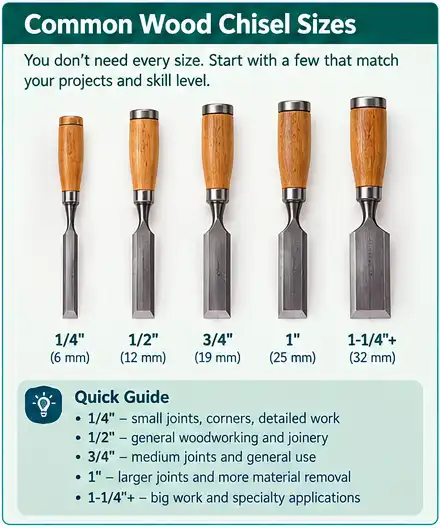
You do not need a large collection of chisels when starting woodworking.
For general work, a small selection of widths can cover many common tasks.
A practical beginner selection could include:
| Chisel Width | Typical Uses |
| 1/4 inch | Small joints, corners, detailed work |
| 1/2 inch | General woodworking and joinery |
| 3/4 inch | General work and medium-sized joints |
| 1 inch | Larger joints and removing more material |
| 1-1/4 inch+ | Larger work and specialty applications |
These are not strict rules. The best sizes depend on your projects.
For example, someone who mainly makes small boxes may need different widths from someone building doors or furniture.
Woodcraft similarly recommends starting with a basic set of four bevel-edge bench chisels around 1/4, 1/2, 3/4, and 1 inch for general shop use.
How to Choose the Right Wood Chisel
Before buying a chisel, consider these factors.
1. Think About Your Work
Start with the job, not the brand.
Ask yourself:
- Do I make furniture?
- Do I cut dovetails?
- Do I make mortise-and-tenon joints?
- Do I install hinges?
- Do I do carving?
- Do I mainly do small DIY projects?
Your answers will determine the type of chisel you need.
2. Choose the Right Chisel Type
For most general woodworking:
Bevel-edge or bench chisels are a practical starting point.
For mortising:
Mortise chisels make more sense.
For delicate fitting:
Paring chisels provide better control.
For decorative carving:
Carving chisels are designed for that purpose.
For heavy chopping:
Firmer or dedicated mortise chisels may be more appropriate.
3. Consider Blade Quality
The blade should be capable of taking and holding a sharp edge appropriate for the work.
Do not judge steel quality only by a marketing term such as “premium steel.”
Instead, consider:
- Edge retention
- Ease of sharpening
- Flatness of the back
- Overall blade construction
- Manufacturer information
- Replacement availability
4. Check the Handle
Handle design affects comfort and how the tool responds in your hand.
Wooden handles can provide a traditional feel and good balance. Composite handles can offer durability and resistance to impact.
If you plan to strike the chisel frequently, make sure the handle is designed for that type of use.
5. Set or Individual Chisels?
Buy a set if:
- You are just starting
- You need several common sizes
- You do not already own chisels
- You want a general-purpose collection
Buy individual chisels if:
- You already have a basic set
- You need one specific width
- You are replacing a damaged tool
- Your projects require specialty chisels
A beginner does not need to buy a large specialty set immediately.
How We Chose What Matters in a Wood Chisel
For this guide, the focus is on tool type, intended use, versatility, size, construction, and ease of choosing the right tool for a particular woodworking task.
We do not treat a single brand or product as universally best.
For product-specific recommendations, we evaluate individual chisels separately based on their stated specifications, intended use, design, and available product information.
That distinction is important because a chisel that works well for fine paring may not be the right choice for heavy mortising.
How to Use a Wood Chisel?
Using a chisel safely is as important as choosing the right one.
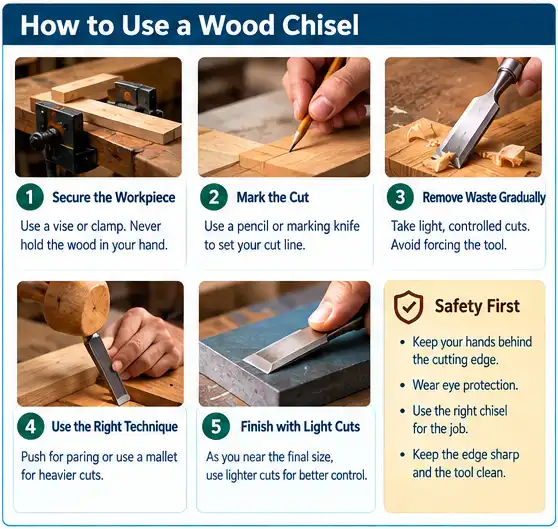
Step 1: Secure the Workpiece
Do not hold a small piece of wood in your hand while pushing a sharp chisel toward it.
Use a vise, clamp, or another suitable method to keep the workpiece stable.
Step 2: Mark the Cut
Use a pencil, marking knife, or other suitable layout tool to establish the cutting line.
For precise joinery, a clear layout line helps you control where the chisel should stop.
Step 3: Remove Waste Gradually
Do not try to remove a large amount of wood in one cut.
Make controlled cuts and approach the final line gradually.
Step 4: Use the Correct Cutting Method
For paring, use controlled hand pressure.
For heavier chopping, use an appropriate woodworking mallet and a chisel designed for impact.
Step 5: Finish With Light Cuts
As you approach the final dimension, reduce the amount of material removed with each cut.
This gives you better control and reduces the chance of damaging the edge or workpiece.
Woodworking guidance recommends light, controlled cuts and avoiding excessive force, especially when working near a layout line.
For more information see our guide How to Use a Wood Chisel: Step-by-Step Technique?
Bevel Up or Bevel Down?
The correct orientation depends on the task.
For many paring operations, the flat back can rest against the workpiece to help control the cut.
For certain roughing, corner, or concave-surface cuts, bevel-down positioning may provide better control.
The important point is that bevel-up and bevel-down are techniques, not rules that apply to every cut. Lee Valley Tools
How to Keep a Wood Chisel Sharp
A sharp chisel is easier to control and generally requires less force.
Common signs that a chisel needs attention include:
- Rough or torn cuts
- Increased cutting force
- The edge slipping from the intended line
- Visible nicks
- Poor control during paring
For a complete sharpening procedure, see:
How to Sharpen a Wood Chisel in 5 Easy Steps
The goal is not simply to make the edge look shiny. The blade needs a consistent, properly maintained cutting edge.
Wood Chisel Safety Tips
Always treat a wood chisel as a sharp cutting tool.
Follow these basic rules:
- Secure the workpiece before cutting.
- Keep your free hand behind the cutting edge.
- Cut away from your body whenever practical.
- Use controlled pressure.
- Use a suitable mallet for striking.
- Do not use a damaged chisel.
- Keep the cutting edge protected when the tool is stored.
- Wear appropriate eye protection when chips may be produced.
Lee Valley’s safety guidance similarly recommends clamping the work, keeping both hands behind the cutting edge, and positioning chisels safely when stored on the bench.
Wood Chisel vs Cold Chisel
These two tools are not interchangeable.
A wood chisel is designed for cutting and shaping wood.
A cold chisel is a metalworking tool designed for cutting metal and other hard materials.
Do not use a wood chisel as a substitute for a cold chisel.
For a detailed comparison, see:
Wood Chisel vs Cold Chisel: What’s the Difference?
Wood Chisel vs Carving Chisel
The two tools serve different purposes.
| Feature | Woodworking Bench Chisel | Carving Chisel |
| Main purpose | Joinery and general woodworking | Decorative carving |
| Blade | Usually straight | Often specialized shapes |
| Typical work | Joints, trimming, mortises | Curves, details, patterns |
| Mallet use | Common with suitable models | Depends on design |
| Best for beginners | General woodworking | Carving projects |
If your goal is furniture, cabinets, or joinery, start with general-purpose woodworking chisels rather than a carving set.
Should Beginners Buy Expensive Wood Chisels?
Not necessarily.
A beginner should first choose a chisel that:
- Fits the intended work
- Has a sound blade
- Can be sharpened properly
- Feels comfortable in the hand
- Is appropriate for the amount of impact it will receive
A more expensive chisel can offer advantages in steel, finish, handle design, or edge performance, but price alone does not make a tool appropriate for a particular job.
If you are ready to compare actual products, see our separate Best Wood Chisels for Beginners guide.
Common Wood Chisel Mistakes
Using the Wrong Chisel
A paring chisel is not a substitute for a heavy mortise chisel.
Taking Cuts That Are Too Deep
Large cuts can cause tear-out and reduce control.
Working With a Dull Edge
A dull edge often encourages excessive force.
Ignoring Grain Direction
Wood fibers can tear when you cut against an unfavorable grain direction.
Using Excessive Hammer Force
Heavy blows can damage the edge, handle, or workpiece when the chisel is not designed for that level of impact.
Holding the Workpiece in Your Hand
This creates an unnecessary injury risk. Secure the workpiece first.
Wood Chisel Maintenance and Storage
Good maintenance extends the useful life of your chisels.
After use:
- Remove wood dust and debris.
- Check the cutting edge for damage.
- Touch up the edge when necessary.
- Keep the blade dry.
- Protect the cutting edge during storage.
- Store chisels where the edges cannot contact each other.
For a deeper guide: Chisel Maintenance and Storage: The Ultimate Guide
Which Wood Chisel Should You Start With?
If you are a beginner doing general woodworking, a small set of bevel-edge bench chisels is usually a sensible starting point.
If your work is more specific:
| Your Main Work | Chisel Type to Consider |
| General woodworking | Bevel-edge / bench |
| Dovetails | Bevel-edge |
| Mortise and tenon | Mortise |
| Fine fitting | Paring |
| Heavy chopping | Firmer / mortise |
| Door hinges | Bevel-edge / butt or suitable hinge chisel |
| Decorative carving | Carving |
| Small DIY repairs | General-purpose bench chisel |
This is a use-case guide, not a ranking. The correct choice depends on the work you actually do.
Frequently Asked Questions (FAQs)
What is a wood chisel used for?
A wood chisel is used to cut, pare, shape, and remove wood. Common applications include joinery, mortising, trimming, dovetails, hinge recesses, and cleaning corners.
What is the best type of wood chisel for beginners?
For general woodworking, a small set of bevel-edge or bench chisels is a practical starting point because they can handle many common tasks.
What size wood chisels should a beginner buy?
A useful starting range is around 1/4, 1/2, 3/4, and 1 inch for general woodworking. Your ideal sizes depend on the projects you plan to make.
What is the difference between a bench chisel and a mortise chisel?
A bench chisel is a general-purpose tool for chopping and paring. A mortise chisel has a thicker, stronger blade designed for chopping and cleaning mortises.
Can you use a wood chisel with a hammer?
Some woodworking chisels are designed to be struck with a mallet. Always follow the manufacturer’s intended use. For many woodworking tasks, a wooden or suitable woodworking mallet is preferable to striking a traditional wooden handle with a steel hammer.
How often should I sharpen a wood chisel?
Sharpening frequency depends on how often you use the tool, the wood you work with, and the condition of the edge. Light honing can often be done before the edge becomes badly dull.
Can a wood chisel cut metal?
A wood chisel should not be used as a metal-cutting tool. Use a suitable metalworking chisel for metal.
Are expensive wood chisels worth it?
They can be, depending on your needs. Better steel, handle design, construction, and edge performance may justify a higher price, but beginners do not necessarily need premium chisels.
What is the difference between a wood chisel and a carving chisel?
A general woodworking chisel is designed mainly for joinery, trimming, chopping, and paring. Carving chisels use specialized blade shapes for decorative and sculptural work.
Final Thoughts
Wood chisels are simple tools, but choosing the right type makes a major difference in woodworking.
For general projects, start with a practical set of bevel-edge or bench chisels. Add mortise, paring, carving, or other specialty chisels only when your projects require them.
More importantly, learn how to sharpen, control, and safely use your chisels. A well-maintained basic chisel can be more useful than a large collection of tools that are poorly matched to the job.
If you are ready to compare specific products, continue to our Best Wood Chisels for Beginners guide.
For technique, see How to Sharpen a Wood Chisel and Wood Chisel vs Cold Chisel.
Related Article:
- How to Use a Woodworking Chisel: Step-by-Step Techniques for Precision
- Narex Chisels Review: Best Value Woodworking Chisels in 2025
- Best 10 Milwaukee Cutting Tools: The Perfect Companion for Your DIY Projects
- The 5 Best Makita Rotary Hammer: Dominate Your Projects 2024
- 14 Different Types of Bricklaying Tools (How to Use Them) in 2024
- 33 Different Types of Wrenches in the USA | How to Use Them?