A good scribing tool helps you transfer the shape of a wall, cabinet, trim piece, or other surface to your workpiece. This is useful when you need a close fit around uneven walls, corners, floors, countertops, and other irregular surfaces.
For woodworking and carpentry, most scribing tools use a pencil or graphite lead instead of a sharp metal point. This makes the line easy to see and works well on wood, laminate, drywall, and similar materials.
We compared five best scribing tools for woodworking based on their design, adjustment system, marking method, and intended use.
Quick answer: Milescraft ScribeTec is a flexible option for general woodworking, while FastCap AccuScribe Pro is designed for consistent offset marking around cabinets, countertops, moldings, and flooring. Trend EasyScribe offers a wider adjustable offset range, and Saker adds several marking functions in one compact tool. Profiler+ uses stainless-steel bearings and works with pencils or markers.
Read more about scribing tools, their types, uses, and how to choose the right one.
Table of Contents
Quick Comparison
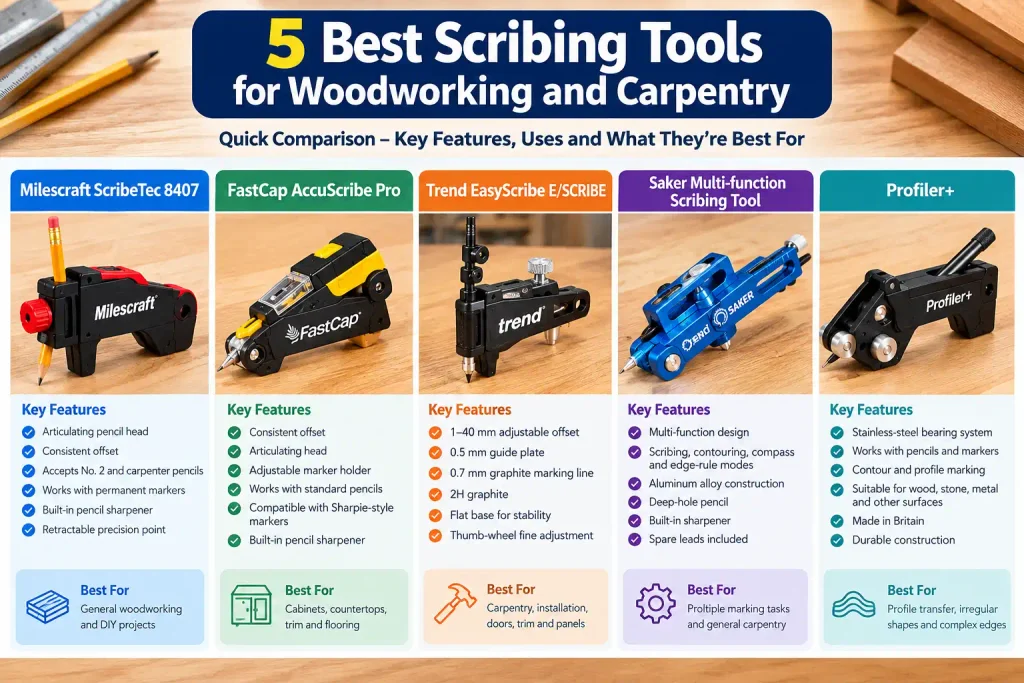
| Scribing Tool | Best suited to | Main feature |
| Milescraft ScribeTec 8407 | General woodworking and DIY | Articulating pencil head |
| FastCap AccuScribe Pro | Cabinets, trim and countertops | Consistent offset |
| Trend EasyScribe E/SCRIBE | Carpentry and installation | 1–40 mm offset adjustment |
| Saker Multi-function Scribing Tool | Multi-purpose woodworking | Multiple marking modes |
| Profiler+ | Profile and contour scribing | Stainless-steel bearing system |
How We Chose?
We focused on features that matter when scribing wood and other common project materials:
- Consistent offset: The tool should help maintain an even gap from the reference surface.
- Adjustment: Different projects need different scribe widths.
- Contour handling: A flexible head can help follow curved or uneven surfaces.
- Marking system: Pencil or graphite makes the line easy to see and adjust.
- Ease of use: Simple adjustments are useful when working on trim, cabinets, flooring, or panels.
- Build materials: We considered the construction and stated materials of each tool.
We did not rank these tools by hands-on testing or assign numerical ratings.
5 Best Scribing Tools for Woodworking & Carpentry
1. Milescraft ScribeTec 8407
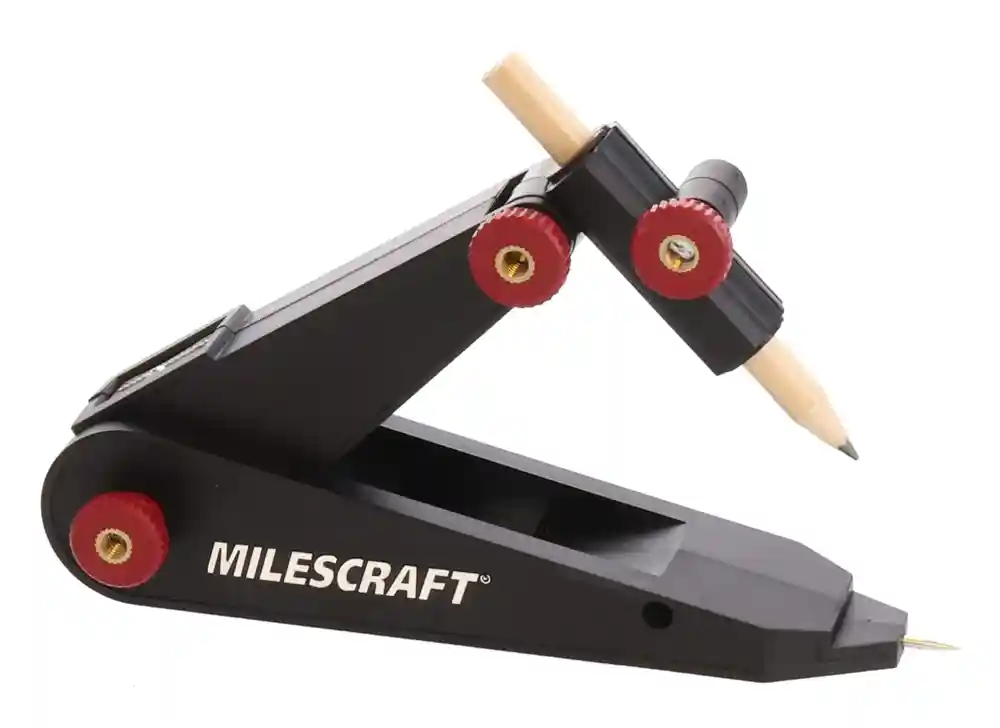
Best for: General woodworking and DIY
Design: Articulating pencil-based scribing tool
Material: ABS plastic and steel
Special feature: Built-in pencil sharpener and retractable precision point
The Milescraft ScribeTec is designed for keeping a consistent scribe offset while following the edge or contour of a work surface. Its articulating pencil head can adjust to different angles, making it useful for molding, cabinet trim, flooring, and other woodworking projects.
The tool accepts No. 2 pencils, carpenter pencils, and Sharpie-style markers. It also has a built-in sharpener and a retractable, spring-loaded precision point. Milescraft states that the included pencil setup can be used to draw circles up to 16 inches in diameter.
Key features
- Articulating pencil head
- Maintains a consistent scribe offset
- Accepts No. 2 and carpenter pencils
- Can hold compatible permanent markers
- Built-in pencil sharpener
- Retractable precision point
- Can draw circles up to 16 inches in diameter
Why consider it?
The ScribeTec combines several useful marking functions in a compact tool. It is particularly suited to woodworking projects where you need to follow an edge while keeping a pencil line at a consistent distance.
Best suited to: Cabinets, molding, flooring, trim, DIY woodworking, and general layout work.
Amazon: Check Price on Amazon
2. FastCap AccuScribe Pro
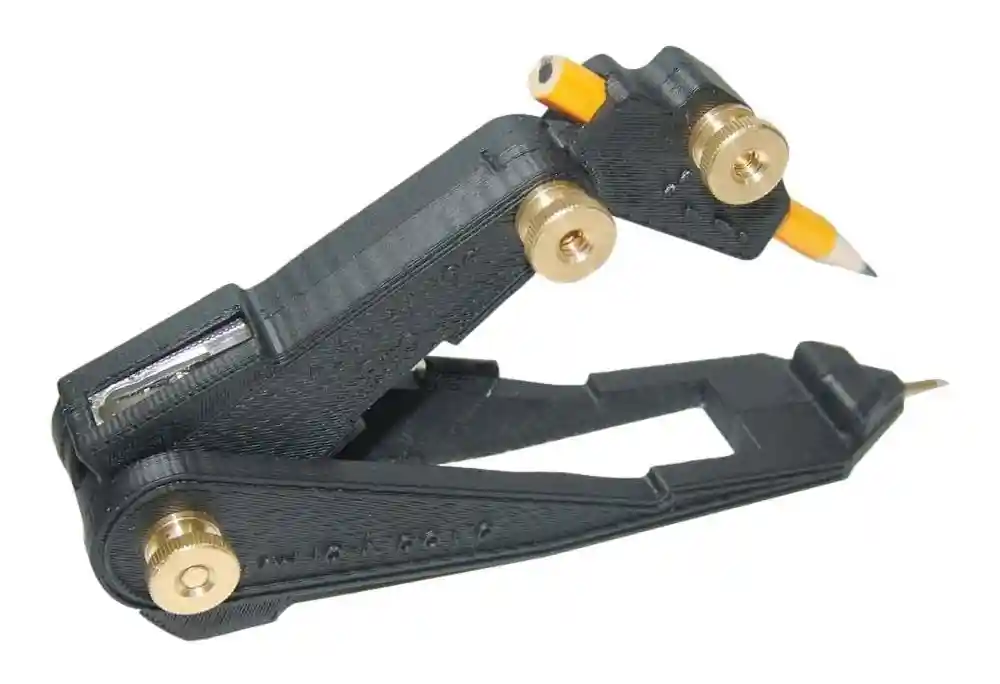
Best for: Cabinets, countertops, trim, and flooring
Design: Articulating scribing tool
Marking method: Standard pencil or marker
Special feature: Consistent offset
The FastCap AccuScribe Pro is designed to maintain a consistent offset while following uneven surfaces. FastCap lists cabinets, moldings, countertops, backsplashes, tile, and flooring among its intended applications.
The Pro model can hold a standard pencil, Sharpie, or FatBoy marker. It also has an articulating head and built-in pencil sharpener.
Key features
- Consistent scribe offset
- Articulating head follows contours
- Adjustable marking tool holder
- Works with standard pencils
- Compatible with Sharpie-style markers
- Built-in pencil sharpener
- Designed for cabinets, countertops, moldings, and flooring
Why consider it?
The AccuScribe Pro is built around one common woodworking problem: transferring an uneven surface to a workpiece while keeping the marking line parallel to that surface.
That makes it useful for fitting trim, cabinets, countertops, and other materials where a straight measuring line may not follow the actual surface.
Best suited to: Cabinet installation, trim work, countertops, flooring, and finish carpentry.
Amazon: Check Price on Amazon
3. Trend EasyScribe E/SCRIBE
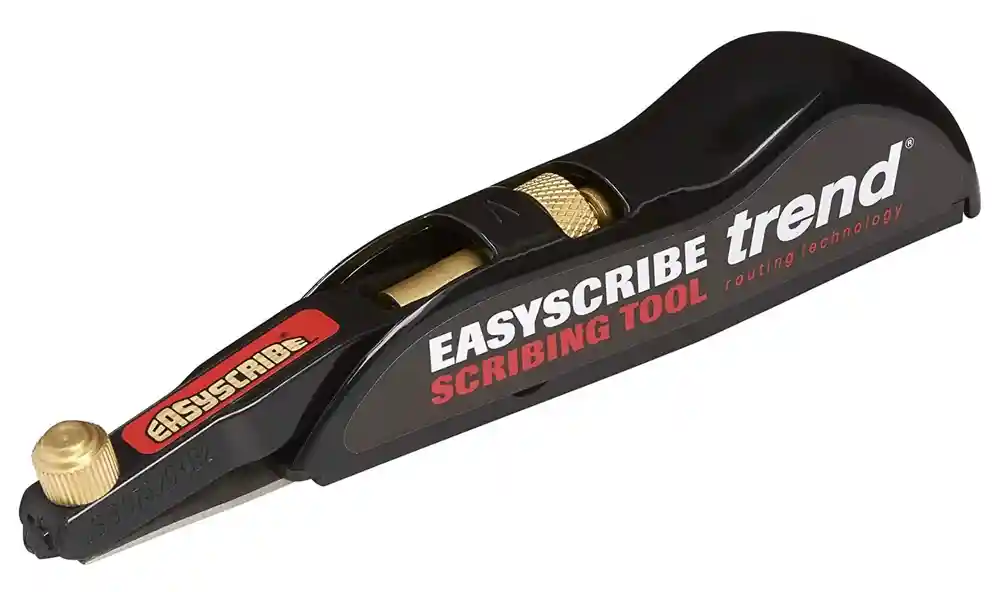
Best for: Carpentry and installation work
Offset range: 1–40 mm
Guide plate: 0.5 mm
Marking line: 0.7 mm, 2H graphite
The Trend EasyScribe is designed for fitting work such as doors, worktops, skirting, architraves, flooring, window boards, and panels.
Its articulated arm allows the offset to be adjusted from 1 mm to 40 mm. Trend also specifies a 0.5 mm guide plate, a flat base, thumb-wheel fine adjustment, and a narrow 0.7 mm graphite line. The guide plate can project up to 50 mm.
Key features
- 1–40 mm adjustable offset
- 0.5 mm thin guide plate
- 0.7 mm graphite marking line
- 2H graphite
- Flat base for consistent contact
- Thumb-wheel fine adjustment
- Up to 50 mm guide-plate projection
- Can also work as a marking gauge
Why consider it?
The EasyScribe is especially useful when you need a controlled offset during installation. Its adjustment range makes it suitable for both small gaps and wider scribing jobs.
It can also reach narrow spaces where a larger guide plate may be difficult to position.
Best suited to: Doors, worktops, skirting, architraves, flooring, panels, and installation work.
Amazon: Check Price on Amazon
4. Saker Multi-function Scribing Tool (BLACK)
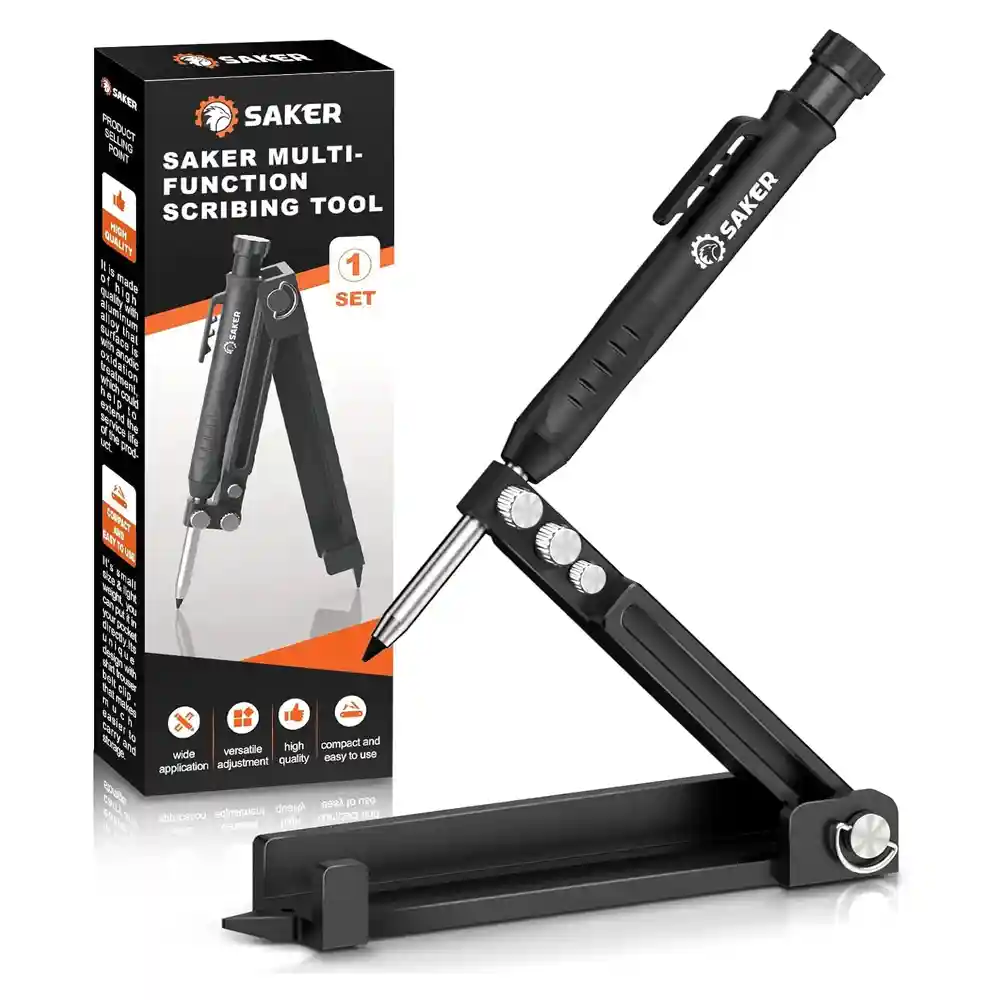
Best for: Multi-purpose woodworking and carpentry
Material: Aluminum alloy
Weight: About 0.22 lb
Design: Adjustable multi-function scribing tool
The Saker Multi-function Scribing Tool is designed to combine several marking functions in one compact tool. Saker describes four main modes: scribing, contouring, compass, and edge-rule functions.
The current product information lists an aluminum-alloy body, a deep-hole pencil, spare leads, and an adjustable design that can be locked after adjustment. Saker also states that the tool has more than 15 marking applications.
Key features
- Adjustable multi-function design
- Scribing and contouring functions
- Compass mode
- Edge-rule function
- Aluminum-alloy construction
- Deep-hole pencil
- Built-in sharpener
- Compact design
- Spare leads included
Why consider it?
A multi-function tool can be useful when a project requires more than one type of layout work. Instead of carrying separate tools for some marking tasks, the Saker can be adjusted for different applications.
Its compact size also makes it convenient to carry in a tool belt or toolbox.
Best suited to: Cabinets, doors, trim, panels, irregular edges, and general carpentry layout.
Amazon: Check Price on Amazon
5. Profiler+ Multifunction Scribing Tool
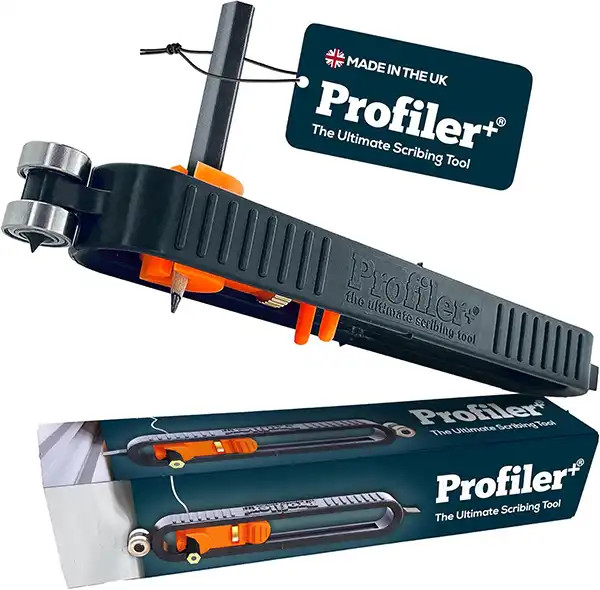
Best for: Profile and contour scribing
Marking method: Pencil or marker
Tip system: Stainless-steel bearings
Origin: Made in Britain
Profiler+ is designed for transferring profiles across different surfaces. The manufacturer says it can mark wood, stone, metal, and other materials, and it works with pencils or markers.
Its marking system uses stainless-steel bearings rather than a conventional sharp scribing point. The manufacturer describes the bearings as a way to trace surfaces while reducing the chance of damaging them.
Key features
- Stainless-steel bearing system
- Works with pencils and markers
- Designed for profile and contour marking
- Suitable for wood, stone, metal, and other surfaces
- Made in the UK
- Designed for woodworking and general fitting work
Why consider it?
Profiler+ takes a different approach to scribing. Instead of relying on a sharp point, it uses bearings to follow a surface while the pencil or marker creates the line.
This is useful for transferring complex profiles or working on surfaces where you want to avoid scratching.
Best suited to: Cabinet fitting, flooring, woodworking, profile transfer, and irregular shapes.
Amazon: Check Price on Amazon
Which Scribing Tool Should You Choose?
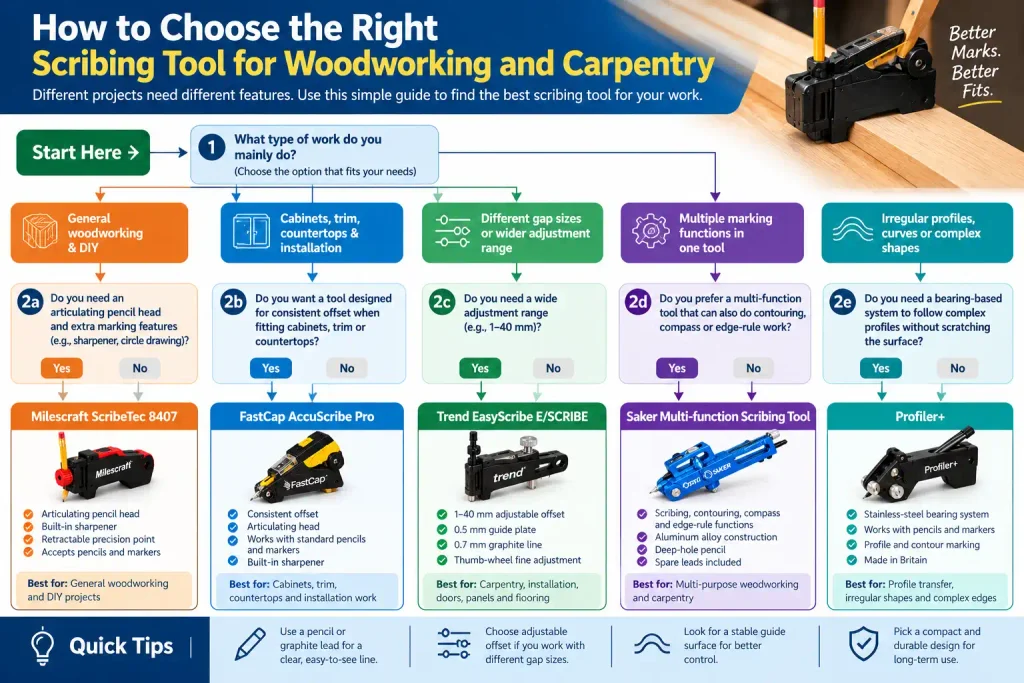
Your best choice depends mainly on the type of work you do.
For general woodworking
Look for a tool that can maintain a consistent offset and work with a normal pencil.
Milescraft ScribeTec fits this type of work with its articulating pencil head and flexible marking setup.
For cabinets and countertops
A tool designed to follow uneven surfaces can make fitting easier.
FastCap AccuScribe Pro is specifically designed for cabinets, countertops, moldings, backsplashes, and flooring.
For adjustable offsets
If you often work with different gap sizes, adjustment range becomes important.
Trend EasyScribe provides a 1–40 mm offset range and a thin guide plate for narrow gaps.
For multiple marking tasks
If you want one tool that can perform several layout functions, consider a multi-function design.
Saker Multi-function Scribing Tool provides scribing, contouring, compass, and edge-rule functions.
For complex profiles
If your work involves irregular shapes and you want a bearing-based approach, Profiler+ is another option to consider.
What to Look for in a Woodworking Scribing Tool
1. Adjustable offset
An adjustable offset lets you control the distance between the reference surface and your marking line.
This is useful when fitting:
- Cabinets
- Baseboards
- Trim
- Shelves
- Countertops
- Flooring
- Panels
2. Stable contact surface
The tool should stay stable against the reference surface.
A flat or wide guide surface can help reduce unwanted movement as you make the mark.
3. Easy-to-see marking line
For woodworking, a pencil or graphite line is often easier to see than a fine scratch.
It also gives you the option to erase or adjust the line before cutting.
4. Contour handling
If the surface is curved or uneven, an articulating head or bearing-based design can help maintain contact.
5. Compact design
A compact tool is easier to keep in a tool pouch or toolbox and can be useful when working on installation jobs.
How to Use a Scribing Tool for Woodworking
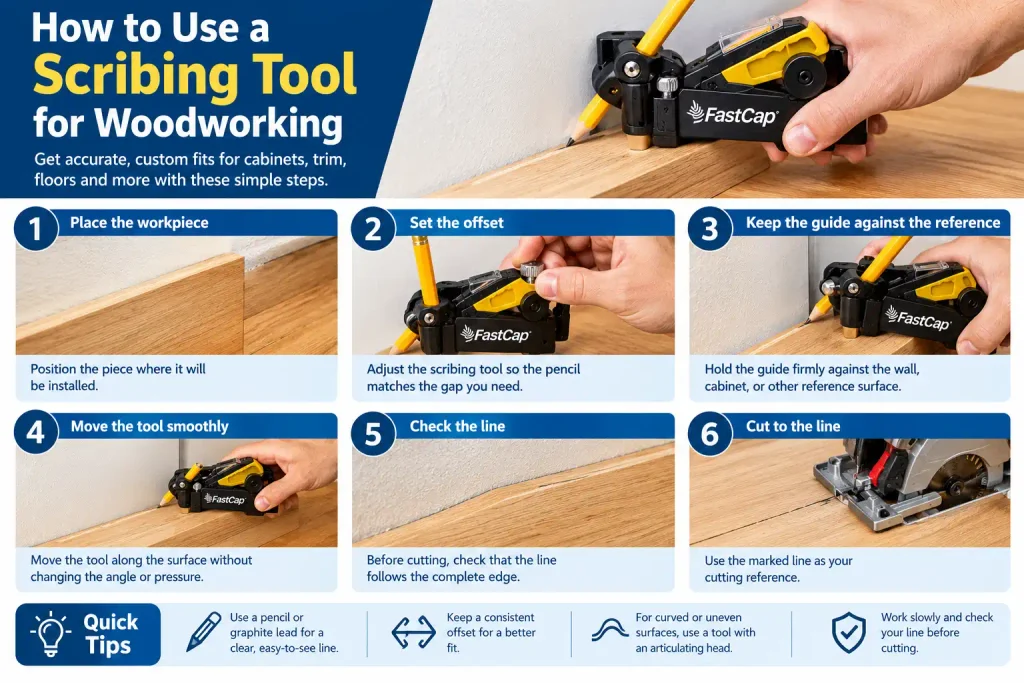
The basic process is simple:
Step 1: Place the workpiece
Position the piece where it will eventually be installed.
Step 2: Set the offset
Adjust the scribing tool so the pencil or marking point matches the gap you need to remove.
Step 3: Keep the guide against the reference surface
Hold the guide firmly against the wall, cabinet, floor, or other reference edge.
Step 4: Move the tool smoothly
Move the tool along the surface without changing the angle or pressure.
Step 5: Check the line
Before cutting, check that the line follows the complete edge.
Step 6: Cut to the line
Use the marked line as your cutting reference.
For a more detailed explanation of choosing a scribing tool, see our guide on how to choose the right scribing tool.
Scribing Tool vs. Pencil
A normal pencil is fine for simple measurements.
A scribing tool becomes more useful when you need to copy an uneven surface while keeping a consistent offset.
For example, placing a cabinet against an uneven wall may require a line that follows the wall instead of a straight measurement.
That is where a dedicated scribing tool can save time.
Scribing Tool vs. Contour Gauge
These tools have different jobs.
A contour gauge copies the shape of an edge or profile.
A scribing tool transfers that shape or edge to another workpiece while maintaining a controlled offset.
Some multi-function scribing tools combine parts of both functions.
Do You Need an Expensive Scribing Tool?
Not necessarily.
For simple trim and woodworking jobs, a basic adjustable scribing tool may be enough.
More advanced designs can be useful when you regularly work with:
- Uneven walls
- Cabinets
- Countertops
- Complex profiles
- Flooring
- Large installation projects
Choose based on the work you actually do rather than buying the most expensive tool.
Frequently Asked Questions (FAQs)
What is a scribing tool used for in woodworking?
A scribing tool is used to transfer the shape or edge of one surface to another workpiece. It is useful when fitting cabinets, trim, flooring, countertops, shelves, and other pieces against uneven surfaces.
What is the best scribing tool for woodworking?
There is no single tool that fits every woodworking job. A tool with consistent offset adjustment is useful for general work, while specialized designs may be better for cabinets, installation, or complex profiles.
For a broader explanation, see our complete guide to scribing tools.
Can you use a scribing tool on cabinets?
Yes. Many woodworking scribing tools are specifically designed for cabinet fitting. FastCap, Milescraft, Trend, and Saker all describe applications involving cabinets, trim, panels, or similar fitting work.
What is the difference between a scribing tool and a pencil?
A pencil creates a line based on where you place it. A scribing tool helps keep the pencil at a controlled distance from a reference surface.
Can I use a scribing tool for baseboards?
Yes. Adjustable scribing tools are useful for transferring uneven wall or floor profiles to baseboards and trim.
Are scribing tools useful for countertops?
Yes. Tools such as the FastCap AccuScribe Pro and Trend EasyScribe are designed for applications that include countertops or worktops.
Final Thoughts
A good woodworking scribing tool can make fitting work easier when walls, floors, cabinets, or other surfaces are not perfectly straight.
For general woodworking, look for a tool that is easy to adjust and keeps a consistent offset. For cabinet and countertop work, an articulating design can help follow uneven surfaces. If you need a wide adjustment range, Trend EasyScribe is worth considering. For multiple marking functions, Saker offers a more versatile design.
Before buying, consider the material you work with, the size of the offset you need, the type of profiles you copy, and how often you use the tool.
For metalworking applications, see our guide to the best metal scribing tools.
Related Articles: