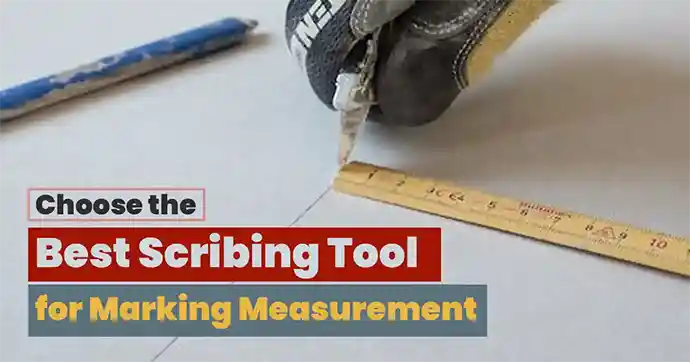
Choosing a scribing tool is easier when you start with the job and material, rather than the tool’s appearance or price.
A tool that works well for sheet-metal layout may not be the right choice for cabinet installation. Likewise, a carbide metal scriber can be useful for marking metal, while a marking knife may be more suitable for fine woodworking.
The right choice depends mainly on what you are marking, how precise the line needs to be, and whether you need a fixed, adjustable, or profile-copying tool.
In this guide, we’ll explain how to choose a scribing tool for metal, woodworking, carpentry, cabinet installation, and general DIY work.
Quick answer: Choose a dedicated metal scriber for metal layout, a marking knife for fine woodworking layout, and a profile scribing tool when you need to transfer irregular shapes or edges.
What Should You Consider When Choosing a Scribing Tool?
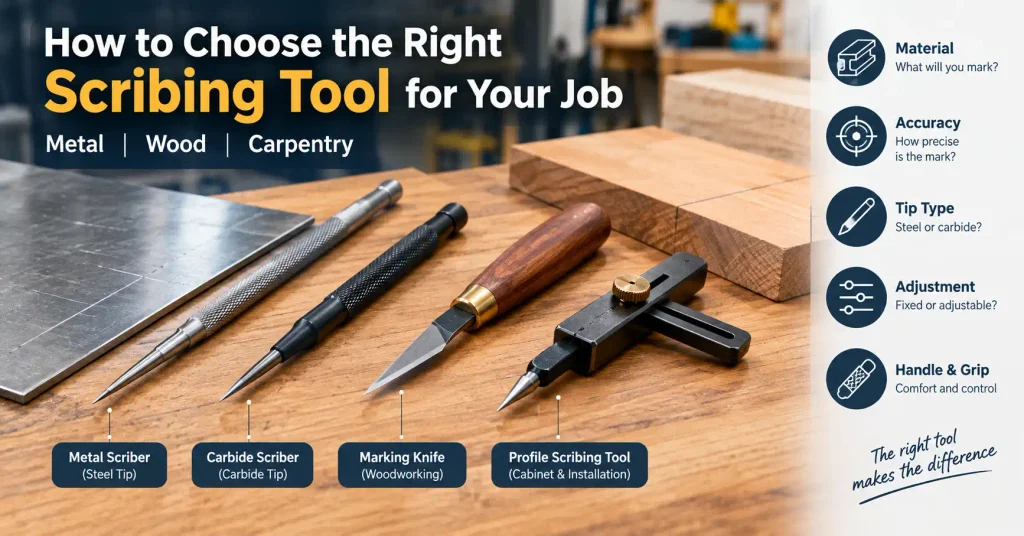
Before buying a scribing tool, consider these six factors:
- Material — What will you mark?
- Type of marking — Do you need a straight line, offset, or profile?
- Tip material — Is a steel or carbide point more suitable?
- Accuracy — How fine and precise must the mark be?
- Adjustment — Do you need a fixed or adjustable tool?
- Handle and durability — Will you use it occasionally or regularly?
There is no single scribing tool that is ideal for every job. Choosing according to these factors can help you avoid buying a tool that does not fit your application.
1. Choose the Tool Based on the Material
The material you are marking should be one of your first considerations.
Different materials require different marking methods, and a tool designed for metal layout may not produce the best result on wood.
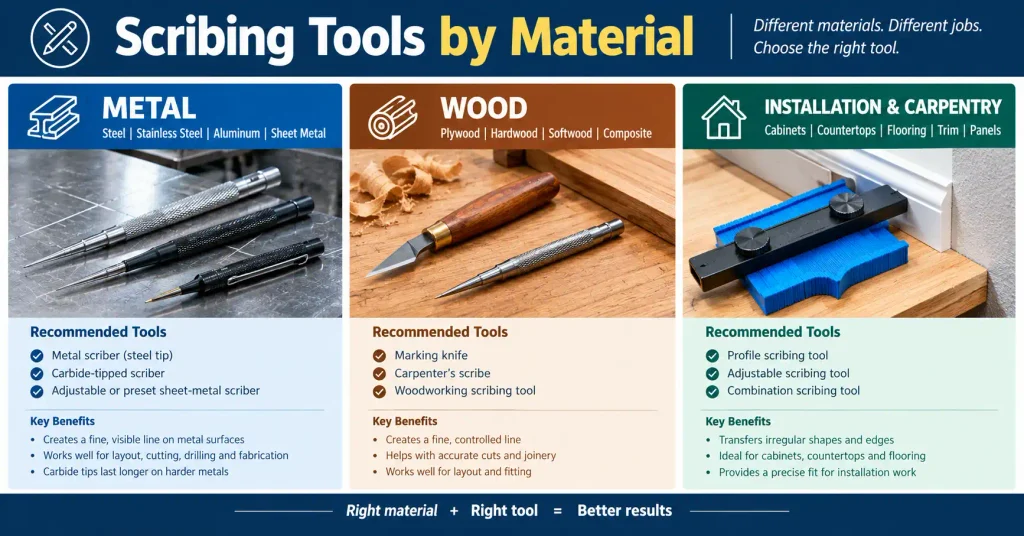
For Metal
Metal scribers are designed to create a narrow physical mark on a metal surface.
They are commonly used for layout work before operations such as cutting, drilling, bending, or fitting.
For general metal marking, a hardened steel point may be suitable. For harder materials or frequent metalworking, a carbide-tipped point can be a useful option because carbide is highly wear resistant.
For sheet-metal work, an adjustable or purpose-built sheet-metal scriber can be useful when you need consistent offsets from an edge.
If your main requirement is metal layout, see our guide to the best metal scribing tools.
For Wood
Woodworking requires a different approach.
A sharp marking knife is often useful when you need a fine, controlled line across or along a wood surface. A pencil can be more practical when the line does not need to be extremely fine.
For woodworking, the best choice depends on whether you are marking a cut line, transferring a dimension, or fitting one part against another.
A metal scriber can mark wood, but it may not always be the most practical choice for fine woodworking layout.
For Cabinet and Installation Work
Installation work often involves transferring the shape of an existing wall, floor, cabinet, or other surface onto a workpiece.
In these situations, a profile scribing tool can be more useful than a simple pointed scriber.
These tools are designed to help transfer irregular shapes and maintain an offset while fitting materials into uneven spaces.
This makes them useful for cabinet fitting, trim work, flooring, countertops, and similar installation tasks.
2. Decide What Type of Scribing You Need
Not every scribing job requires the same type of tool.
Think about the type of line or shape you need to transfer.
Straight-Line Scribing
For a simple straight reference line, a basic scriber may be enough.
Metalworkers can use a pointed scriber to create a fine line on a metal workpiece. Woodworkers may prefer a marking knife or pencil depending on the required accuracy.
The simpler the job, the less specialized the tool needs to be.
Fixed-Offset Scribing
Sometimes you need to mark a line at a consistent distance from an edge.
A fixed-offset scribing tool can make this task easier because the distance between the guide and marking point remains consistent.
This is particularly useful for repeated layout work.
Adjustable Scribing
An adjustable scribing tool allows you to change the distance between the guide and the marking point.
This can be useful when working with different dimensions or when you need to make several offsets.
An adjustable design is worth considering if you regularly perform layout work with changing measurements.
For occasional use, however, a simple fixed tool may be enough.
Profile Scribing
Profile scribing is different from simple line marking.
The goal is to copy an irregular edge or shape onto another workpiece.
A profile scribing tool can help you transfer shapes around:
- Uneven walls
- Pipes
- Corners
- Trim
- Cabinet edges
- Countertops
- Flooring
- Other irregular surfaces
If your main task is fitting material around an uneven shape, look for a tool designed specifically for profile scribing.
3. Pay Attention to the Tip Material
The tip is one of the most important parts of a scriber.
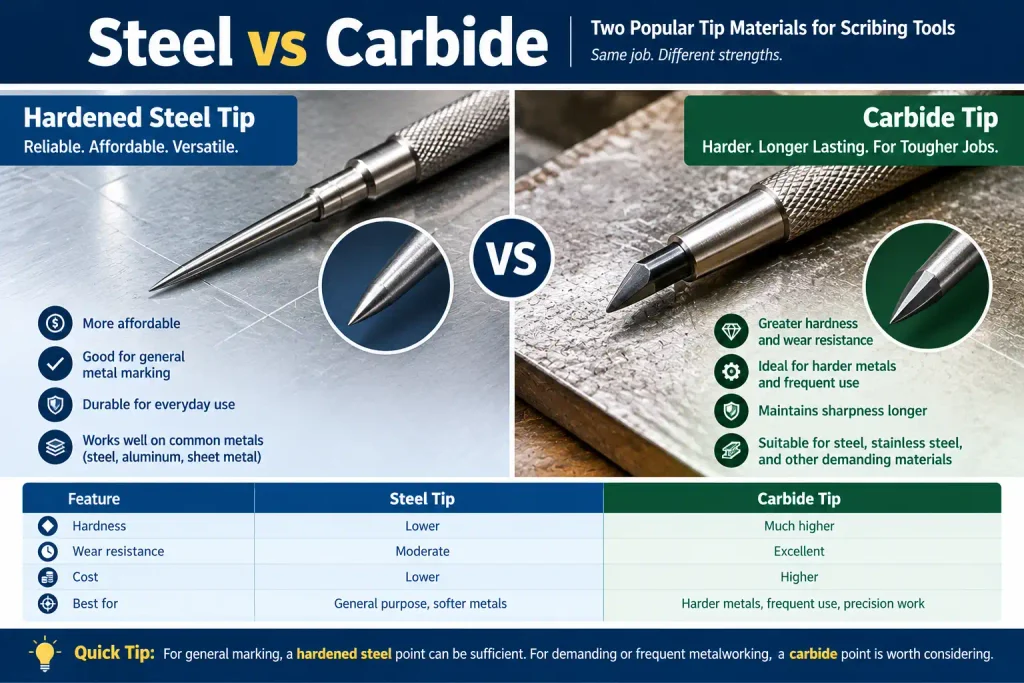
Two common choices are hardened steel and carbide.
Hardened Steel Tip
A hardened steel point can be a practical choice for general marking work.
It can provide a fine point and is suitable for many common workshop applications.
Consider a steel-point scriber when:
- You need general-purpose marking
- You work with common metals
- You want a simple tool
- You do not use the tool continuously
Carbide Tip
Carbide is significantly harder than ordinary steel and is commonly used where a durable marking point is needed.
A carbide-tipped scriber can be useful for frequent metalworking and for marking harder metal surfaces.
Consider carbide when:
- You frequently mark metal
- Tip durability is important
- You work with harder materials
- You want a long-lasting marking point
Simple rule:
For general marking, a quality steel-point tool may be sufficient. For demanding or frequent metalworking, a carbide point is worth considering.
4. Consider How Much Accuracy You Need
Think about how precise your layout needs to be.
For rough DIY work, a pencil or basic marking tool may be enough.
For precision machining or metal fabrication, you may need a tool capable of producing a narrow, controlled line.
Consider the following:
General DIY
A basic scriber or versatile marking tool may be sufficient.
Woodworking
A sharp marking knife can be useful for fine layout work.
Metalworking
A dedicated metal scriber can provide a narrow physical reference line.
Precision Layout
A high-quality point, comfortable handle, and controlled marking technique become more important.
The more precise the work, the more important it is to choose a tool designed for that specific application.
5. Fixed or Adjustable: Which Is Better?
The answer depends on how you work.
Choose a fixed tool if:
- You perform simple marking tasks
- You usually work with one type of layout
- You want a simple design
- You do not need repeated adjustment
Choose an adjustable tool if:
- You work with different offsets
- You make repeated layout marks
- You need consistent distances
- You want greater flexibility
An adjustable tool is not automatically better. If you only need basic marking, its additional adjustment may not provide much benefit.
6. Check the Handle and Grip
A scriber may look simple, but the handle still matters.
If you use the tool frequently, look for a handle that gives you good control.
Useful features may include:
- Knurled or textured grip
- Comfortable diameter
- Good balance
- Durable construction
- Secure point storage
For a pocket scriber, compact size can also be important.
For workshop use, however, a slightly larger handle may be easier to control during repeated marking.
Which Scribing Tool Should You Choose?
Use the following guide as a quick starting point.
| Your Job | Suitable Tool |
| Sheet-metal layout | Sheet-metal scriber |
| General metal marking | Steel or carbide scriber |
| Harder metal surfaces | Carbide scriber |
| Stainless steel marking | Suitable carbide or hardened-point scriber |
| Repeated edge offsets | Preset or adjustable scriber |
| Fine woodworking layout | Marking knife |
| Cabinet installation | Profile scribing tool |
| Copying irregular shapes | Profile scribing tool |
| General DIY | Basic scriber or versatile marking tool |
| Portable precision marking | Pocket scriber |
Remember that this is a starting guide rather than a strict rule. Your material, working method, and required accuracy should determine the final choice.
Metal Scriber vs. Marking Knife
A metal scriber and marking knife can both create precise marks, but they are designed for different applications.
| Feature | Metal Scriber | Marking Knife |
| Main use | Metal layout | Fine woodworking |
| Typical surface | Metal | Wood |
| Mark type | Fine physical line | Fine cut/mark |
| Common users | Machinists, metalworkers | Woodworkers, cabinetmakers |
| Best suited for | Metal layout | Joinery and wood layout |
For metalworking, choose a dedicated metal scriber.
For fine woodworking layout, a marking knife is often more appropriate.
Metal Scriber vs. Scratch Awl
A scratch awl is another useful marking tool, but it should not always be treated as a direct replacement for a scriber.
A scratch awl has a pointed shaft and is commonly used for marking, starting holes, or working with leather and other materials.
A dedicated scriber is generally designed more specifically for fine layout marking.
If you want to understand the differences between these marking tools, see our complete guide to scribing tools, their types, uses, and how to choose the right one.
Do You Need an Expensive Scribing Tool?
Not necessarily.
The right tool depends more on the job than the price.
A basic scriber may be perfectly suitable for occasional DIY work. A professional machinist or fabricator may benefit from a more specialized tool with a durable point, better grip, or adjustable design.
Before spending more, ask:
- What material will I mark?
- How often will I use the tool?
- How precise must the mark be?
- Do I need adjustment?
- Is portability important?
- Do I need a carbide point?
If a simple tool meets your requirements, there may be little reason to pay for additional features.
Common Mistakes When Choosing a Scribing Tool
Avoid these common mistakes when selecting a tool.
Choosing by Price Alone
A higher price does not automatically make a tool suitable for your application.
Choose based on the job, material, and required accuracy.
Choosing the Wrong Tip
A tool designed for general marking may not be ideal for demanding metalworking.
Consider the tip material before buying.
Ignoring Adjustment
If you repeatedly need a specific offset, a fixed scriber may become inconvenient.
An adjustable tool may save time in this situation.
Using a Specialized Tool for the Wrong Job
A metal scriber, marking knife, and profile scribing tool solve different problems.
Do not assume that one tool can replace all three.
Buying More Features Than You Need
If you only make occasional straight marks, an advanced adjustable tool may be unnecessary.
Keep the tool matched to the work.
How to Choose a Scribing Tool: Quick Decision Guide
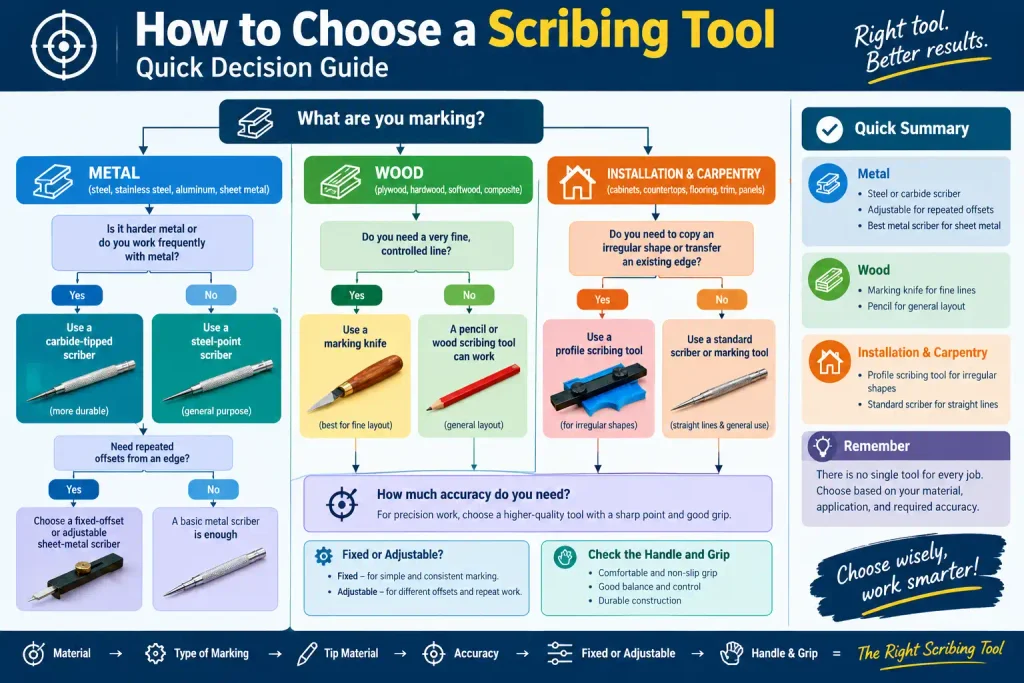
Use these questions to narrow down your choice.
Are you marking metal?
Yes → Consider a dedicated metal scriber.
Are you marking harder metal or doing frequent metalworking?
Yes → Consider a carbide-tipped scriber.
Do you need a consistent offset from an edge?
Yes → Consider a fixed-offset or adjustable scribing tool.
Are you doing fine woodworking layout?
Yes → Consider a marking knife.
Are you copying an irregular shape?
Yes → Consider a profile scribing tool.
Do you need a portable marking tool?
Yes → Consider a compact pocket scriber.
Do you only need occasional general-purpose marking?
Yes → A basic scriber may be enough.
Frequently Asked Questions
What is the best scribing tool for metal?
The right tool depends on the type of metal and the marking job. A dedicated metal scriber is a practical choice for general metal layout, while a carbide-tipped scriber can be useful for demanding or frequent metalworking.
For product comparisons, see our guide to the best metal scribing tools.
What is the best scribing tool for woodworking?
For fine woodworking layout, a sharp marking knife is often a useful choice. A pencil may be more practical for general layout where an extremely fine line is not required.
The right choice depends on the type of woodworking and the accuracy needed.
Is carbide better than steel for a scriber?
Carbide is harder and more wear resistant than ordinary steel, so a carbide point can be useful for frequent or demanding metal marking.
However, a quality hardened steel point can be sufficient for many general-purpose applications.
Can I use a metal scriber on wood?
Yes, a pointed scriber can physically mark wood, but it may not always be the best choice.
For fine woodworking layout, a marking knife can provide better control for certain tasks.
Should I buy an adjustable scribing tool?
Consider an adjustable tool if you frequently need different offsets or repeatable distances from an edge.
If your marking jobs are simple and consistent, a fixed tool may be sufficient.
What is the difference between a scriber and a marking knife?
A scriber is commonly used to create fine layout marks, especially on metal. A marking knife is primarily used for precise woodworking layout.
They can perform similar marking functions, but their designs and common applications differ.
What is a scribing tool used for?
A scribing tool is used to create a fine reference mark on a workpiece. Depending on the tool, it can be used for metal layout, woodworking, carpentry, cabinet installation, profile transfer, and other precision marking tasks.
For a complete explanation of scribing tools and their different types, see our complete guide to scribing tools.
Final Thoughts
Choosing a scribing tool becomes much easier when you start with the material, application, and required accuracy.
For metalworking, look for a suitable metal scriber and consider the point material. For fine woodworking, a marking knife may be more appropriate. If you need to transfer irregular shapes, a profile scribing tool can be a better fit.
You also need to decide whether you need a fixed or adjustable tool and whether portability, grip, or tip durability matters for your work.
There is no need to choose the most expensive tool. Choose the tool that matches the job you actually do.
If you want to learn more about the different types and uses of these tools, read our guide to scribing tools, their types, uses, and how to choose the right one.
If your main goal is accurate metal layout, you can also compare the best metal scribing tools.