A good metal scribing tool helps you create a fine, controlled reference line before cutting, drilling, bending, or fitting metal. Unlike a broad marker line, a scriber creates a narrow physical mark that can be easier to follow during precision layout work.
But not every scribing tool is designed for the same job.
Some are made specifically for sheet-metal offsets. Others use carbide points for general metal marking, while pocket scribers are designed for portability and precision.
In this guide, we compare 9 metal scribing tools based on their design, tip material, adjustment options, intended use, and manufacturer specifications.
Quick answer: If you need an adjustable tool for sheet-metal layout, the Malco A60 is worth considering. For a carbide-point option, the Malco A50 is designed for applications including hardened steel and sheet metal. For preset sheet-metal offsets, the Malco A40 and Midwest MWT-A2 are purpose-built options.
Quick Comparison: Best Metal Scribing Tools
| Tool | Type | Tip / Point | Best For |
| Malco A60 | Adjustable sheet-metal scribe | Steel | Adjustable sheet-metal layout |
| Malco A50 | Carbide-tipped scriber | Carbide | Harder materials and metal marking |
| Malco A40 | Pocket sheet-metal scribe | Dual-edged point | Repeatable sheet-metal offsets |
| Midwest MWT-A2 | Preset-depth scribe | Scribing point | Sheet-metal layout |
| Speedway Motors Large Scribe | Edge scribe | Scribe needle | Fabrication and panel work |
| Starrett 70AX | Pocket scriber | Carbide | Precision pocket marking |
| Empire 27023 | Pocket scriber | Hardened carbide | General metal marking |
| Beta 1688PC | Engineer’s scriber | Hardened-steel point | Precision workshop layout |
| Moody 51-1521 | Reversible pocket scriber | Tungsten carbide | Compact metal marking |
Our Top Metal Scribing Tool Picks
- Best Adjustable Sheet-Metal Scribe: Malco A60
- Best Carbide-Tipped Option: Malco A50
- Best for Repeatable Sheet-Metal Offsets: Malco A40
- Best Preset-Depth Option: Midwest MWT-A2
- Best for Fabrication Panel Work: Speedway Motors Large Scribe
- Best Precision Pocket Scriber: Starrett 70AX
- Best Affordable Carbide Scriber: Empire 27023
- Best Engineer’s Scriber: Beta 1688PC
- Best Compact Reversible Scriber: Moody 51-1521
These categories describe different use cases rather than claiming that one tool is universally better than every other option.
1. Malco A60 Adjustable Sheet Metal Scribe
Best for: Adjustable sheet-metal layout
Point: Steel
Adjustment: 1/4 to 12-1/2 inches
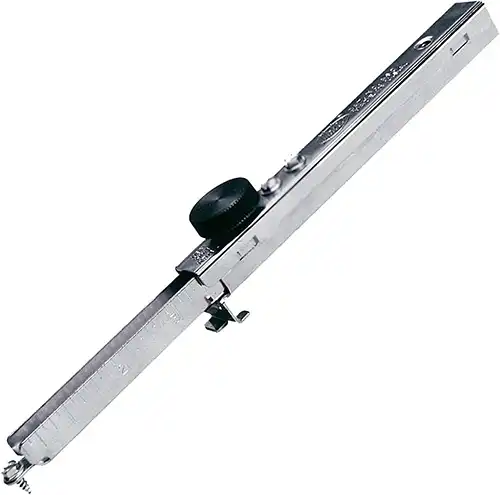
The Malco A60 is designed specifically for measuring, marking, and scribing sheet metal. Its adjustable design lets you set the desired marking depth and guide the tool along the edge of the workpiece.
According to Malco, the A60 adjusts from 1/4 inch to 12-1/2 inches and uses a steel point. The manufacturer also states that it can be used on stainless steel and alloy steel. A replacement point is available.
Key features
- Adjustable from 1/4 to 12-1/2 inches
- Steel scriber point
- Graduated adjustment
- Designed for sheet-metal layout
- Replaceable point
- Pocket-size design
Why consider it?
The A60 makes sense when your work requires different scribing depths rather than one fixed offset.
Best suited to: HVAC, sheet-metal fabrication, repair work, and repeated edge-offset layouts.
Amazon: Check Price on Amazon ↗
2. Malco A50 Carbide-Tipped Scribe
Best for: Carbide-point metal marking
Point: Carbide
Design: Retractable point
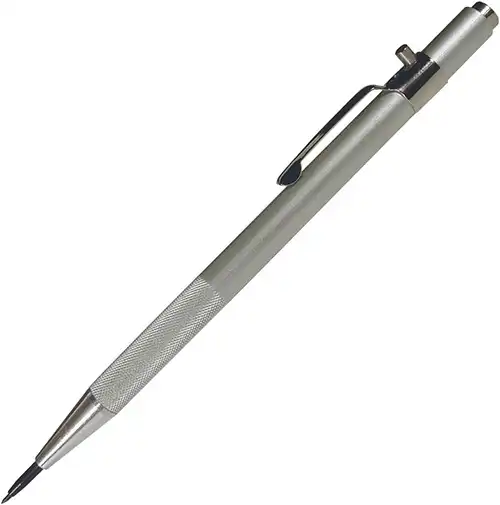
The Malco A50 takes a different approach from the A60. Instead of an adjustable edge guide, it is a compact carbide-tipped scriber designed for fine marking.
Malco states that the A50 can mark hardened steel, sheet metal, glass, ceramics, and plastics. The carbide tip is retractable and replaceable.
Key features
- Carbide tip
- Retractable point
- Replaceable tip
- Pocket clip
- Compact design
- Suitable for fine marking
Why consider it?
If you prefer a traditional pointed scriber rather than an adjustable sheet-metal tool, the A50 provides a compact option.
It is especially interesting for users who work with materials where a carbide point is appropriate.
Amazon: Check Price on Amazon ↗
3. Malco A40 Pocket Sheet Metal Scribe
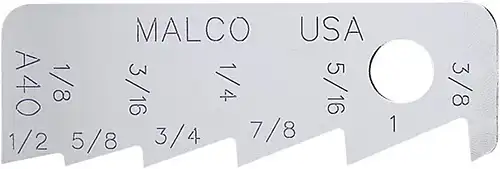
Best for: Repeatable sheet-metal offsets
Point: Dual-edged scribing point
Depths: 1/8 to 1 inch
The Malco A40 is designed for common sheet-metal trim lines. Instead of continuously adjusting the tool, you select from preset depths.
Malco specifies 10 preset scribing depths from 1/8 inch to 1 inch. Each position uses a dual-edged point designed to produce a line parallel to the edge of the sheet.
Key features
- 10 preset depths
- 1/8 to 1-inch range
- Compact pocket design
- Dual-edged point
- Corrosion-resistant finish
- Etched depth markings
Why consider it?
The A40 is useful when your work involves common, repeatable sheet-metal offsets and you do not need the much wider adjustment range of the A60.
Amazon: Check Price on Amazon ↗
4. Midwest MWT-A2 Scribe Marker
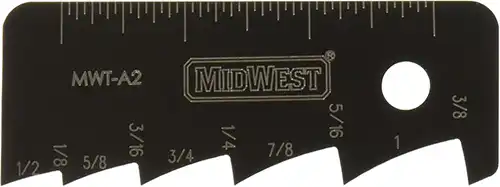
Best for: Preset-depth sheet-metal marking
Type: Sheet-metal scribe marker
Depths: 1/8 to 1 inch
The Midwest MWT-A2 is another purpose-built sheet-metal scribe with preset depth positions.
Midwest lists 10 preset scribing depths from 1/8 inch to 1 inch and describes the tool specifically for scribing sheet metal.
Key features
- 10 preset depths
- 1/8 to 1-inch range
- Easy-to-read depth markings
- Designed for sheet metal
- Made in the USA
Why consider it?
If you regularly make common offset marks on sheet metal, a preset-depth design can be simpler than measuring every offset manually.
Amazon: Check Price on Amazon ↗
5. Speedway Motors Large Sheet Metal Scribe
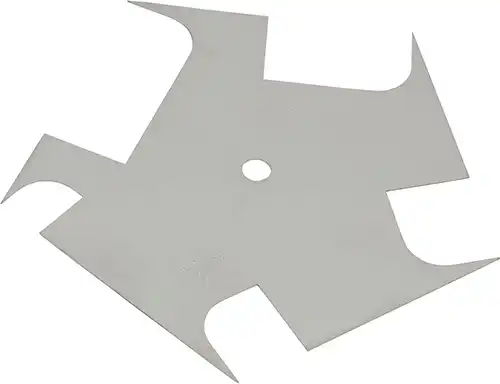
Best for: Fabrication and panel work
Construction: Stainless steel
Depths: 0.50, 0.75, 1, 1.5, and 2 inches
The Speedway Motors Large Sheet Metal Scribe uses the edge of the material as a guide while its needle follows the desired offset.
The manufacturer listing specifies stainless-steel construction and five preset depths: 0.50, 0.75, 1, 1.5, and 2 inches.
Key features
- Stainless-steel construction
- Five preset depths
- Edge-guided design
- Designed for metalworking
- Useful for panel layout
Why consider it?
Its larger offset range makes it interesting for fabrication and automotive panel work, especially when you need offsets greater than the 1-inch range found on many compact sheet-metal scribes.
Amazon: Check Price on Amazon ↗
6. Starrett 70AX Pocket Scriber

Best for: Precision pocket scribing
Point: Tungsten carbide
Point length: 2-3/8 inches (60 mm)
Handle: Knurled, nickel-plated steel
The Starrett 70AX Pocket Scriber is a compact precision marking tool designed for accurate layout work. Its tungsten-carbide point provides a fine marking tip for creating controlled reference lines on metal and other suitable work surfaces.
The 70AX uses a 2-3/8-inch (60 mm) carbide point and a 1/4-inch knurled, nickel-plated steel handle. Its pocket-style design makes it convenient for machinists, metalworkers, and others who need a precision scriber close at hand. The point can also be reversed into the handle for storage and protection.
Key features
- Tungsten-carbide marking point
- 2-3/8-inch (60 mm) point length
- Knurled nickel-plated steel handle
- Compact pocket-scriber design
- Reversible point for storage and protection
- Designed for precision layout and marking
Why consider it?
The Starrett 70AX makes sense when you want a compact, precision-oriented scriber rather than an adjustable sheet-metal offset tool. Its carbide point and pocket-sized design make it especially useful for detailed layout work where a controlled, fine marking point matters.
Best suited to: Machining, metalworking, precision layout, fabrication, and general workshop marking.
Amazon: Check Price on Amazon ↗
7. Empire 27023 Carbide-Tipped Scriber
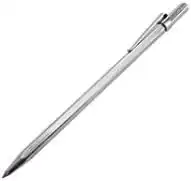
Best for: Affordable general-purpose metal marking
Point: Hardened carbide
Length: 6 inches
The Empire 27023 is a simple pocket-style carbide scriber designed for marking several materials.
Empire specifies a 6-inch body, hardened carbide tip, and pocket clip, and lists machinists, welders, and mechanics among its intended users.
Key features
- Hardened carbide tip
- 6-inch length
- Pocket clip
- Simple pen-style design
- Suitable for metal marking
Why consider it?
This is the type of tool to consider if you want a straightforward carbide scriber without an adjustable sheet-metal mechanism.
Amazon: Check Price on Amazon ↗
8. Beta 1688PC Engineer’s Scriber
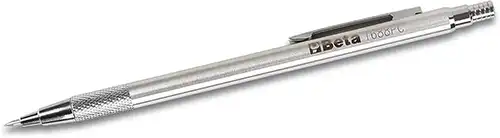
Best for: Precision workshop layout
Design: Engineer’s scriber
Point: Hardened-steel marking point
The Beta 1688PC is a pen-shaped engineer’s scriber designed for accurate marking on metal parts.
Beta’s official product information lists a 150 mm length, 1 mm diameter, and 15 g weight. The manufacturer identifies it as an engineer’s scriber made from chrome-plated hardened steel.
Key features
- 150 mm length
- 1 mm point diameter
- Hardened-steel construction
- Chrome-plated body
- Lightweight design
Why consider it?
The 1688PC is a good fit for users who want a traditional engineer’s scriber for workshop layout rather than an adjustable sheet-metal offset tool.
Important: Some retailers describe this model as a carbide scriber pen, but Beta’s own current product page identifies the 1688PC as an engineer’s scriber made from chrome-plated hardened steel. For accuracy, here we follows Beta’s manufacturer specification.
Amazon: Check Price on Amazon ↗
9. Moody 51-1521 Reversible Pocket Scriber
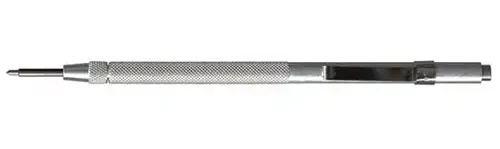
Best for: Compact pocket use
Point: Tungsten carbide
Handle: Anodized aluminum
The Moody 51-1521 is designed as a reversible shirt-pocket scriber. ASC Scientific describes the model as having an anodized aluminum handle, a reversible tungsten-carbide tip, and a pocket clip. The model is also offered with a magnet.
Key features
- Tungsten-carbide tip
- Reversible point
- Anodized aluminum handle
- Pocket clip
- Compact design
- Available with magnet
Why consider it?
The 51-1521 makes sense for people who want a small scriber that can stay in a shirt or workwear pocket.
Amazon: Check Price on Amazon ↗
How We Chose These Metal Scribing Tools
We selected these products based on manufacturer specifications, intended application, tip material, adjustment options, portability, and suitability for metal layout work.
We focused specifically on tools designed for metal marking and layout, rather than general profile-scribing tools intended primarily for woodworking.
We considered:
- Tip or point material
- Supported applications
- Adjustable or preset depth
- Construction
- Portability
- Replaceable points where applicable
- Pocket clips and storage features
- Suitability for sheet metal and general metal layout
- Manufacturer documentation
We did not treat manufacturer claims as hands-on testing results. Product specifications, availability, and pricing can change, so check the manufacturer’s current information before purchasing.
How to Choose the Best Metal Scribing Tool
The best metal scribing tool for you depends mainly on what you mark and how you mark it.
1. Consider the Material
For ordinary sheet-metal layout, a dedicated sheet-metal scribe can be more convenient than a general-purpose pocket scriber.
For harder materials, look for a tool whose manufacturer specifically supports the intended material.
For example, Malco states that the A50 can mark hardened steel, while the A60 is specified for stainless and alloy steel.
2. Choose Between Adjustable and Fixed Depth
If you regularly use different offsets, an adjustable tool such as the Malco A60 can be useful.
If you repeatedly use common dimensions, preset tools such as the Malco A40 or Midwest MWT-A2 may be simpler.
3. Decide Whether You Need Carbide
Carbide is not automatically better for every application.
A carbide point can provide high wear resistance and may be appropriate for harder materials, but a steel-point tool can be perfectly practical for many general layout tasks.
Choose the point material based on the work you actually do.
4. Look for a Replaceable Point
A scribing point eventually wears or becomes damaged.
If you use the tool frequently, a replaceable point can extend its useful life.
The Malco A60 and A50, for example, have replacement-point options.
5. Think About Storage
A pocket clip, retractable point, or reversible point can be useful if you carry the tool around a workshop.
For example, the Starrett 70AX retracts its point into the handle, while the Moody 51-1521 uses a reversible point and pocket clip.
Carbide vs. Hardened Steel Scriber
Both types can be useful.
Carbide
Advantages:
- High wear resistance
- Suitable for applications where carbide is specified
- Useful for fine marking
- Available in retractable and pocket designs
Consider carbide when:
- You frequently perform precision layout
- You need a wear-resistant point
- The manufacturer specifies the material you need to mark
Hardened Steel
Advantages:
- Practical for general layout
- Common in engineers’ scribers
- Can provide a fine marking point
- Often simple to maintain
Consider hardened steel when:
- You need a traditional workshop scriber
- Your materials do not require a carbide point
- You want a simple marking tool
How to Use a Metal Scribing Tool
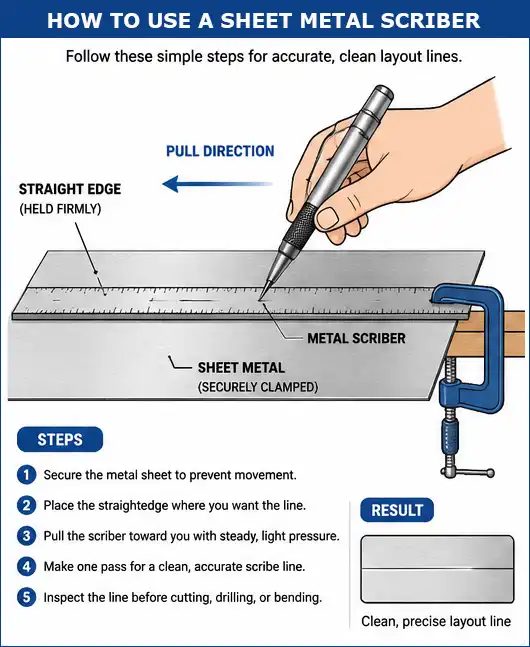
The exact technique depends on the tool.
Step 1: Clean the Surface
Remove dirt, oil, and loose material from the area you need to mark.
Step 2: Measure the Location
Use a ruler, combination square, calliper, or another suitable measuring tool.
Step 3: Establish a Reference
Use an edge, existing hole, centerline, or layout mark as your reference.
Step 4: Position the Scriber
For an edge-guided sheet-metal scribe, keep the guide against the edge while maintaining steady pressure.
For a pocket scriber, use a suitable straightedge or layout guide.
Step 5: Make the Mark
Use controlled pressure and avoid repeatedly dragging the point over the same line unless necessary.
Step 6: Check the Layout
Before cutting or drilling, verify the measuremens and reference points.
Safety tip: A scribed line is a layout aid, not a substitute for proper eye protection and safe cutting or drilling procedures.
Common Metal Scribing Mistakes
Avoid these common problems:
1. Using the Wrong Type of Scriber
A woodworking profile scribe is not necessarily the right tool for metal layout.
2. Choosing Carbide Only Because It Sounds Better
Tip material should match your application.
3. Applying Excessive Pressure
More pressure does not necessarily produce a more accurate line.
4. Measuring From the Wrong Reference
Always establish a reliable datum or reference edge.
5. Using a Damaged Point
A blunt or damaged point can make the line wider or less controlled.
6. Skipping the Final Measurement
Always verify your layout before cutting, drilling, or bending.
Metal Scriber vs. Marker
A permanent marker is quick and highly visible, but its line can be relatively broad.
A metal scriber creates a much finer physical reference line.
For rough fabrication work, a marker may be sufficient. For precision layout, a scriber can provide better control. The right choice depends on the accuracy required for the job.
Metal Scriber vs. Scratch Awl
A scratch awl can also create a physical mark, but its shape and intended use differ from many dedicated metal scribers.
A scriber is generally designed around a fine marking point and controlled layout.
A scratch awl is often more versatile for tasks such as starting holes or marking softer materials.
For detailed differences among scribers, marking knives, awls, and other marking tools, see our complete guide to scribing tools.
Which Metal Scribing Tool Should You Choose?
Choose according to your job:
- For adjustable sheet-metal offsets: Malco A60
- For carbide-point marking: Malco A50
- For common sheet-metal offsets: Malco A40
- For preset-depth sheet-metal work: Midwest MWT-A2
- For fabrication and panel work: Speedway Motors Large Sheet Metal Scribe
- For precision pocket marking: Starrett 70AX
- For a simple carbide scriber: Empire 27023
- For traditional engineering layout: Beta 1688PC
- For compact pocket use: Moody 51-1521
The right choice depends on your material, required marking depth, working environment, and whether you need an adjustable, preset, or simple pointed scriber.
Final Thoughts
The best metal scribing tool depends on the type of layout work you perform.
For adjustable sheet-metal work, the Malco A60 provides a wide adjustment range. For a carbide-point option, the Malco A50 is designed for fine marking applications, including hardened steel and sheet metal.
For repeatable sheet-metal offsets, the Malco A40 and Midwest MWT-A2 provide preset-depth designs.
If you prefer a compact pocket scriber, options such as the Starrett 70AX, Empire 27023, Beta 1688PC, and Moody 51-1521 offer different point and handle designs for workshop marking.
Before buying, focus on the material you need to mark, the required offset or marking depth, point material, portability, and replacement-point availability.
Frequently Asked Questions (FAQs)
What is the best metal scribing tool?
There is no single tool that is ideal for every metal-layout job. The Malco A60 is designed for adjustable sheet-metal offsets, while the A50 provides a carbide-tipped option for applications including hardened steel and sheet metal.
What is the best metal scriber for sheet metal?
For repeatable sheet-metal offsets, the Malco A40 and Midwest MWT-A2 are purpose-built options with preset depths. The A60 is more suitable when you need a wider adjustable range.
Is carbide better than hardened steel?
Not in every situation. Carbide can provide high wear resistance, but hardened steel can be practical for many general layout tasks. Choose according to the material and application.
Can a metal scriber mark stainless steel?
Some can. Always check the manufacturer’s specifications. Malco specifically states that the A60 can be used on stainless steel.
What is the difference between a sheet-metal scribe and a pocket scriber?
A sheet-metal scribe often uses an edge guide or preset/adjustable offset. A pocket scriber is generally a pointed marking tool designed for portability and freehand or guided layout.
Can I sharpen a carbide scriber?
Do not assume that every carbide point should be sharpened. Some models use replaceable points. Check the manufacturer’s instructions for your specific model.
What should I look for in a metal scriber?
Consider the point material, supported materials, marking depth, adjustment system, grip, portability, and replacement-point availability.
Do I need an expensive metal scribing tool?
Not necessarily. A simple carbide or hardened-steel scriber can be enough for many basic layout jobs. More specialized adjustable tools are useful when your work requires repeatable offsets or specific layouts.
This article may contain affiliate links. If you purchase through one of these links, we may earn a small commission at no additional cost to you. Our recommendations are based on product research, manufacturer information, and user feedback. We only recommend products that we believe provide genuine value to our readers.
Related Resources
- Woodworking Scribing Tools vs. Metalworking Scribes: Key Differences
- What Are Metal Scribing Tools, and How Are They Used? (6 Quick Steps)
- Complete Guide to Scribing Tools: 7 Types and Uses for Precision Marking
- 5 Best Carpenters Scribing tool for Easy and Precise Marking
- Choose the Best Scribing Tool for Marking Measurement of Your Job
- 5 Best Carpenter Pencil Sharpeners: A Woodworker’s Guide