

If you’ve ever over-tightened a bolt or stripped a thread, you already know why a torque wrenches are must-have tool. Whether you’re a car mechanic, bike enthusiast, or DIY home user, torque precision matters.
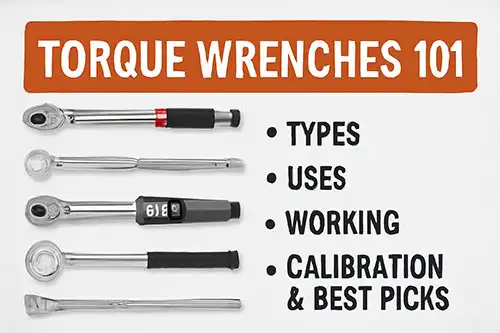
In this complete guide, you’ll learn:
- What a torque wrenches?
- How it works
- Different types of torque wrenches
- How to calibrate them
- And the best torque wrenches models you can buy right now
- More
Let’s dive in!
Some links on this site are affiliate links, and we may earn a commission at no extra cost to you. We only recommend trusted products.
Table of Contents
What is a Torque Wrench?
A torque wrench is a precision hand tool designed to apply a specific amount of torque to a fastener — like a nut or bolt. It ensures bolts are tightened properly to avoid under- or over-tightening, which can cause parts to loosen or damage.
In short, it tells you how tight your bolt should be!
How Does a Torque Wrench Actually Work?
A torque wrench is a special tool that tightens bolts and nuts to exactly the right amount. It prevents you from overtightening or under tightening fasteners. This precision matters for everything from bicycle wheels to car engines.
The basic principle is simple. The wrench measures how much twisting force you’re applying. When you reach the preset amount, it alerts you to stop.
The Click-Type Wrench
The most common type is the click wrench. Inside, there’s a spring and a clutch mechanism. You set your desired torque by turning the handle, which compresses the spring to a specific tension.

As you tighten a bolt, pressure builds against the spring. When the force matches your setting, the internal clutch slips. This creates an audible click and a slight give in the handle. That’s your signal to stop turning.
The Beam Wrench
This older design is even simpler. It uses a long metal beam attached to the handle. As you apply force, the beam bends slightly. A pointer on the beam moves along a scale, showing you the current torque level in real time.
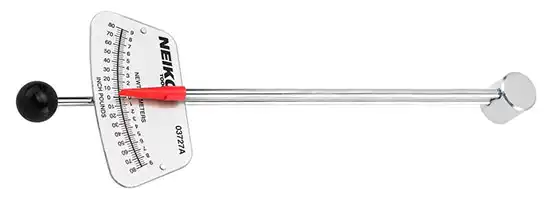
There’s no clicking mechanism here. You just watch the needle and stop when it reaches your target number.
Digital Torque Wrenches
Modern electronic versions use strain gauges. These sensors detect how much the wrench is flexing under load. A computer chip converts this measurement into a torque reading on a digital display.

Many digital models beep or flash when you hit the target. Some even record your measurements for quality control purposes.
Why Precision Matters
Different bolts need different amounts of tightness. Too loose, and parts can fall off or leak. Too tight, and you risk stripping threads or cracking components.
Torque wrenches eliminate guesswork. They ensure consistent, reliable connections every time you use them.
💡 Pro Tip: Always reset your mechanical torque wrench to its lowest setting after use to maintain calibration.
Why is proper torque more important than you think?
Under-torqued fasteners tend to come loose easily. Over-torqued fasteners, on the other hand, stretch and strip the threads. Both of these situations can cost you hundreds or even thousands of dollars.
Real-world examples:
- Wheel falls off → Accident (under-torqued lug nuts are a leading cause of wheel separation)
- Warped brake rotor → $400 repair (over-torqued caliper bolts)
- Blown head gasket → $2,000+ engine rebuild (incorrect cylinder-head bolt torque)
- Striped spark plug threads in aluminum head → $800 helicoil repair
Manufacturers spend millions calculating the correct torque specifications for every bolt on a car. But when you ignore them, you literally void the warranty and put your safety at risk.
Types of Torque Wrench (Full Breakdown)
There are 8 main types. Below is a brief description of each:
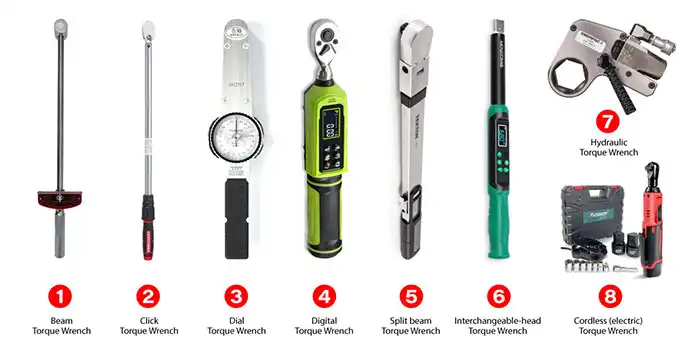
1. Beam-type
This is the granddaddy of them all. The common ones are simple, low-cost, durable, reliable, and almost impossible to break.
How it works: First, a long beam bends slightly when force is applied. The second “pointer” beam remains straight. This results in the correct torque being displayed on the scale.
Pros:
- Never needs calibration
- Extremely durable
- Cheapest option
Cons:
- Hard to read in tight spaces
- Must look at scale when applying torque
Best for: Beginners, bicycles, lawn mowers, budget-conscious DIYers
Average price: $25–$80
Top pick:
- Tekton 1/2″ Beam Torque Wrench (24335) – ~$62 ← Most popular on Amazon in 2025
- Performance Tools M206 1/2″ – ~$35 (Great backup wrench)
2. Click-type (micrometer)
Most popular, easy to use, “click” when torque is reached.
How it works: Twist the handle to set the required torque. This causes a spring-loaded mechanism inside to release and “click” when it reaches the target.
Pros:
- Quick and easy to use with one hand
- Audible and tactile feedback
- Great size and price point
Cons:
- Must be stored at 0 degrees Celsius, or the spring will weaken.
- Can go out of calibration if dropped.
Best for: 95% of automotive work, professional shops, serious DIYers
Average price: $60–$350
Top click-type winners:
- Tekton 24335 1/2-inch (10–150 ft-lbs) – Best overall value (~$65)
- Precision Instruments PREC3FR250F 1/2-inch Split-Beam – Lifetime Warranty Beast (~$280)
- CDI (Snap-On) 2503MFRPH 1/2-inch – Shop Favorite (~$320)
3. Dial
Extremely accurate with dial readout.
How it works: A mechanical dial with a needle shows torque in real time. Some have a memory pointer.
Pros:
- Highly accurate (±2–3%)
- No chance of battery or spring failure
Cons:
- Expensive
- Slow and heavy to use
Best for: Machine shops, engine rebuilders who need visual proof
Average price: $250–$600
4. Digital/Electronic
Displays torque digitally, often with light/beep alerts. This is the new king for accuracy and convenience.
How it works: The strain gauge measures torque and displays it on an LCD. Most beep, flash, and vibrate whenever you hit a target.
Pros:
- Most accurate consumer option (±1–2%)
- Peak-hold and trace modes
- Built-in torque + angle capabilities
Cons:
- Battery dies at the worst possible moment
- High price
Best for: German cars (BMW, VW, Porsche)
Average price: $180–$450
Best digital choice:
- ACDelco ARM601-4 1/2-inch (~$199) – Best value digital
- GearWrench 85077 1/2-inch (~$260) – Bright screen + angle mode
- eTORK 1/2-inch (~$185) – Simple and highly accurate
5. Split-beam (flex-head)
This is the professional’s choice for those who don’t want to keep the handle open. Pre-set style; requires less reset/calibration.
How it works:
Uses a flex joint and separate beams. Once the torque is set, it stays set until you change it.
Pros:
No need to return to zero after use
Quick in production environments
Cons:
More expensive than regular clickers
Best example:
- Precision Instruments PREC3FR250F (~$280) — basically bulletproof and comes with a lifetime warranty.
6. Interchangeable-head
One handle, dozens of heads (open-end, crowfoot, flare-nut, etc.).
Best for: Brake lines, fuel rails, hard-to-reach suspension bolts
Top brands: Capri Tools, Mountz, and CDI
7. Hydraulic
High-force tool for industrial or construction work. This is an industrial monster that can produce 50,000 foot-pounds. Remember, this isn’t for your garage. It’s used in wind turbine work.
8. Cordless (electric)
These days, it’s a huge leap forward. Milwaukee, Makita, and Ingersoll Rand now make 1/2-inch cordless versions that reach 300-1000 foot-pounds.
Best for: Tire shops, heavy equipment
Price: $600-$2,000+
Torque Wrench Drive Sizes – Which One Do You Need?
5 types of drive sizes are given below in table:
| Drive Size | Typical Torque Range | Best Jobs |
|---|---|---|
| 1/4-inch | 4–20 ft-lb (5–30 Nm) | Bicycles, motorcycles, small engines, spark plugs |
| 3/8-inch | 15–80 ft-lb | Suspension, brakes, intake manifolds |
| 1/2-inch | 30–250 ft-lb | Lug nuts, crankshaft bolts, most automotive |
| 3/4-inch | 100–600 ft-lb | Truck lug nuts, heavy equipment |
| 1-inch | 200–1000+ ft-lb | Commercial trucks, construction |